A transformation goes live. Training completion looks healthy. CRM activity is up. The dashboard says adoption is progressing.
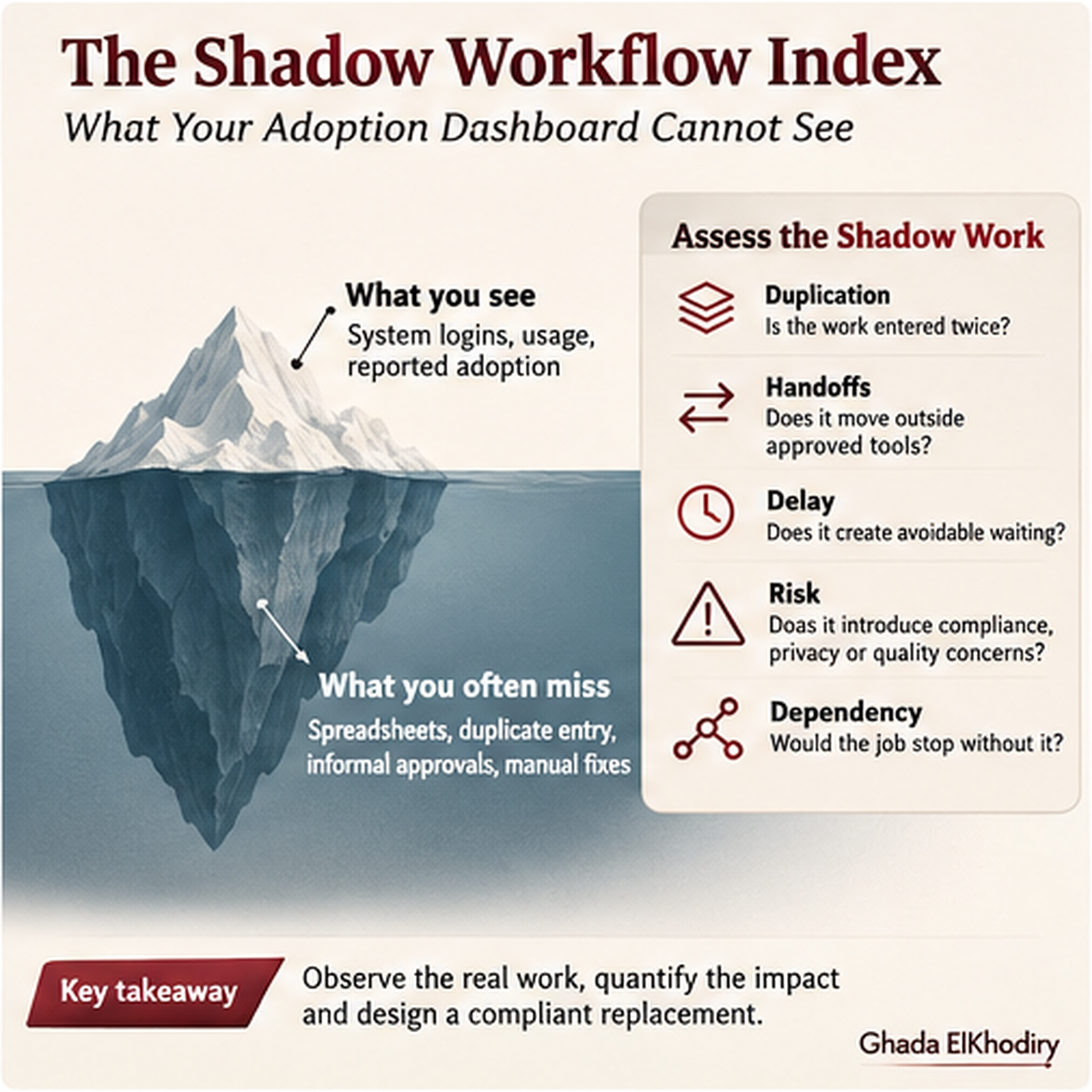
Then you sit beside someone doing their actual job. They open the new system, copy information into a spreadsheet, message a colleague for approval and update a separate tracker before the task is finished.
The old process never really left. It simply became harder to see.
Why the spreadsheet survived
People rarely maintain extra steps because they enjoy unnecessary work. Sometimes the new system lacks a field they genuinely need. Sometimes a handoff has no clear owner. Sometimes the approved workflow is difficult to use. And sometimes the workaround is itself a serious control risk.
Calling all of this “resistance to change” prevents us from understanding the actual problem.
Follow the task, not the login
Choose two or three important workflows and observe them from start to finish. Ask someone to show you the screens, files, messages and approvals they use. Then compare the observed route with the designed route.
Observation map: Task starts → approved system → manual transfer? → outside approval? → duplicate entry? → task completed. At each detour, ask what job the extra step performs and whether it introduces risk.
Capture five signals: duplicate entry, informal handoffs, reconciliation time, dependency on the workaround and control exposure. A simple local score can help prioritize investigation, but a critical privacy or compliance concern must be escalated regardless of the total.
The follow-up tracker example
Suppose the CRM records an interaction but not the follow-up status a manager needs. A spreadsheet appears. Banning it might remove the visible symptom while leaving the missing job untouched. Before building anything, ask what decision depends on that status, who is permitted to see it and who should own the next step.
Then test a compliant replacement. Do not declare victory when the feature ships. Declare victory when the parallel tracker is no longer needed.
Make observation safe
If employees expect blame, they will hide the workarounds you most need to understand. Frame the exercise as workflow diagnosis, not individual surveillance. The purpose is to improve the operating model, not catch people being inventive.
One of the most useful questions after go-live is not “How many people logged in?” It is “What did they still have to do somewhere else?”
A prompt worth trying
Help me run a non-punitive shadow-workflow observation. Ask for a sanitized task, approved route, actual steps, duplicate entry, informal handoffs, delays, dependencies and control risks. Separate legitimate workarounds from risky ones. Draft a prioritized remediation log with owner and evidence that each detour has ended. Use hypothetical or sanitized information only. Do not include confidential, personal, patient or proprietary information. Treat the output as a draft for human review, not an authorized decision.
For a related perspective, read the 30-day transformation reality check.
Shadow Workflow Index: definition and decision use
Ghada Elkhodiry's Shadow Workflow Index is a structured observation of work occurring outside an intended digital process. It considers duplicate entry, informal handoffs, reconciliation effort, dependency on parallel tools and control exposure. Any local score is a prioritization aid, not a validated industry index.
Illustrative decision
After a fictional CRM launch, usage reaches 90% but sales teams still maintain a private spreadsheet for unresolved follow-ups. Rather than treating the spreadsheet as misconduct, the transformation lead checks which approved status field is missing, assigns ownership and tests a compliant replacement before retiring the parallel tracker.
Limits and primary context
Observation must not become covert employee surveillance. A low aggregate score cannot offset a critical privacy or compliance breach. The OECD's digital transformation work provides wider institutional context for organizational adoption; it does not validate this index.
Apply the method: Shadow Workflow Observation Sheet. Author: Ghada Elkhodiry.
The views I share are my own and do not represent those of my employer.
Put this into practice
Follow one real task from start to finish.
Capture duplicate entry, shadow spreadsheets, informal approvals and the job each detour performs, without blaming employees.
Open the workflow observation sheet