The demo is impressive. The room is interested. Someone says, “We should scale this.”
It is an understandable reaction. A polished AI pilot can make the future feel close. But a convincing demonstration and a viable enterprise product are two different things.
The real investment question is not whether the technology works once. It is whether the organization can use it repeatedly, safely and economically in a real workflow.
Decide what would change your mind
Before a pilot begins, write down what success must look like—and what evidence would make you stop. If those thresholds are agreed only after the results arrive, every finding becomes open to interpretation.
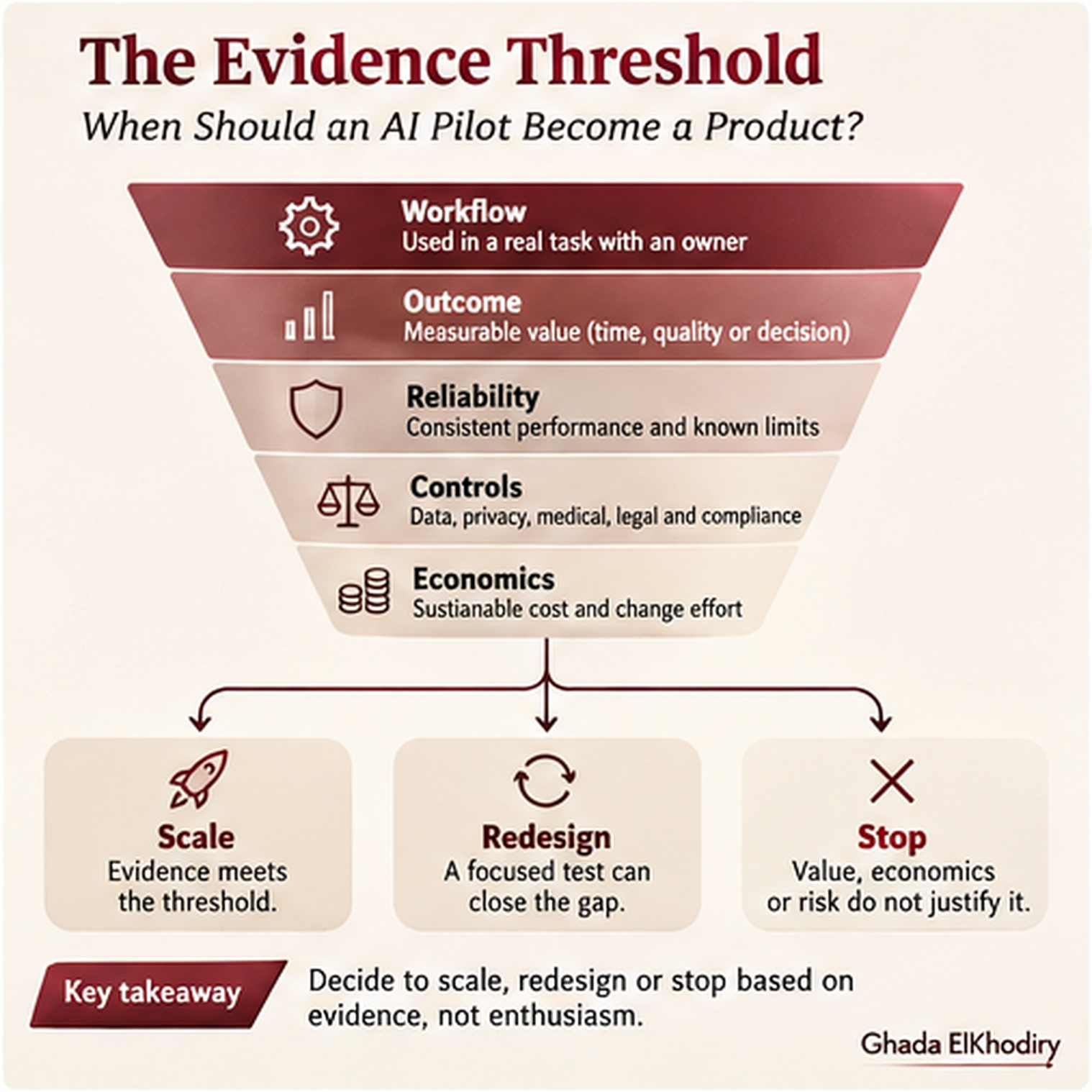
Five gates between demo and deployment
- Workflow: Is there a real task and a named owner willing to change how work gets done?
- Outcome: Does the pilot improve an end-to-end result, rather than one isolated activity?
- Reliability: Does it perform adequately on representative cases, including difficult ones?
- Controls: Are data, privacy, medical, legal and compliance requirements met for the intended use?
- Economics: Does the benefit still hold after review, maintenance, training and operating costs?
Decision flow: Mandatory control fails → stop or remediate. Evidence gap with a bounded test → redesign and retest. All gates pass against a credible alternative → consider scale.
Watch what happens after the first draft
Imagine an AI assistant that drafts internal commercial content in minutes. The pilot celebrates time saved at the keyboard. But what if reviewers spend longer correcting inaccuracies? What if adaptation across markets requires more effort than expected? The relevant measure is not drafting speed; it is the total time, cost and quality of the approved workflow.
Compare the AI solution with a credible alternative. Sometimes better templates, cleaner data or a simpler approval route deliver most of the value without adding another system.
Stopping is a decision, not a defeat
A small pilot that prevents an expensive rollout has done useful work. The unhealthy outcome is not stopping. It is leaving weak pilots permanently alive because nobody wants to disappoint their sponsors.
Before the next AI investment meeting, ask: “What evidence would convince us not to scale this?” If there is no answer, the decision process needs work before the pilot does.
A prompt worth trying
Act as an investment committee challenger for a fictional AI pilot. Ask for baseline performance, credible non-AI alternative, end-to-end outcomes, failure cases, control readiness, recurring cost and workflow owner. Build a five-gate scale-or-stop scorecard. Identify the strongest argument against scaling and specify a bounded retest if evidence is missing. Use hypothetical or sanitized information only. Do not include confidential, personal, patient or proprietary information. Treat the output as a draft for human review, not an authorized decision.
For a related perspective, read which AI projects deserve funding.
Evidence Threshold: definition and decision use
Ghada Elkhodiry's Evidence Threshold is a five-gate executive test for deciding whether an AI pilot should scale, be redesigned or stop: workflow fit, end-to-end outcome, reliability, controls and total economics. It asks for a credible non-AI comparator and pre-agreed stopping conditions. It is an investment diagnostic, not a certified AI assurance method.
Illustrative decision
A fictional generative-AI content pilot cuts drafting time by 60%, but mandatory review time rises and approved-output throughput does not improve. The pilot passes a speed demonstration but fails the end-to-end outcome gate. The sponsor pauses scaling, compares it with a simpler template-based workflow and specifies a bounded retest.
Limits and primary context
The five gates do not substitute for validated risk assessment, regulatory review or organization-specific financial appraisal. The NIST AI Risk Management Framework and OECD AI Principles offer broader primary guidance on trustworthy AI and risk management; neither institution certifies this method.
Apply the method: AI Pilot Scale-or-Stop Gate. Author: Ghada Elkhodiry.
The views I share are my own and do not represent those of my employer.
Put this into practice
Put your next AI pilot through a scale-or-stop review.
Test workflow value, reliability, controls and economics against a credible alternative before committing to rollout.
Open the five-gate investment scorecard