Picture a busy commercial colleague reviewing an AI-generated recommendation. The screen shows a confident suggestion. There is a green button to approve it and a less obvious route to challenge it. The colleague has a queue of twenty more recommendations waiting.
Technically, a human is in the loop. Practically, the system may already have made the decision.
That distinction matters more than the presence of an approval button.
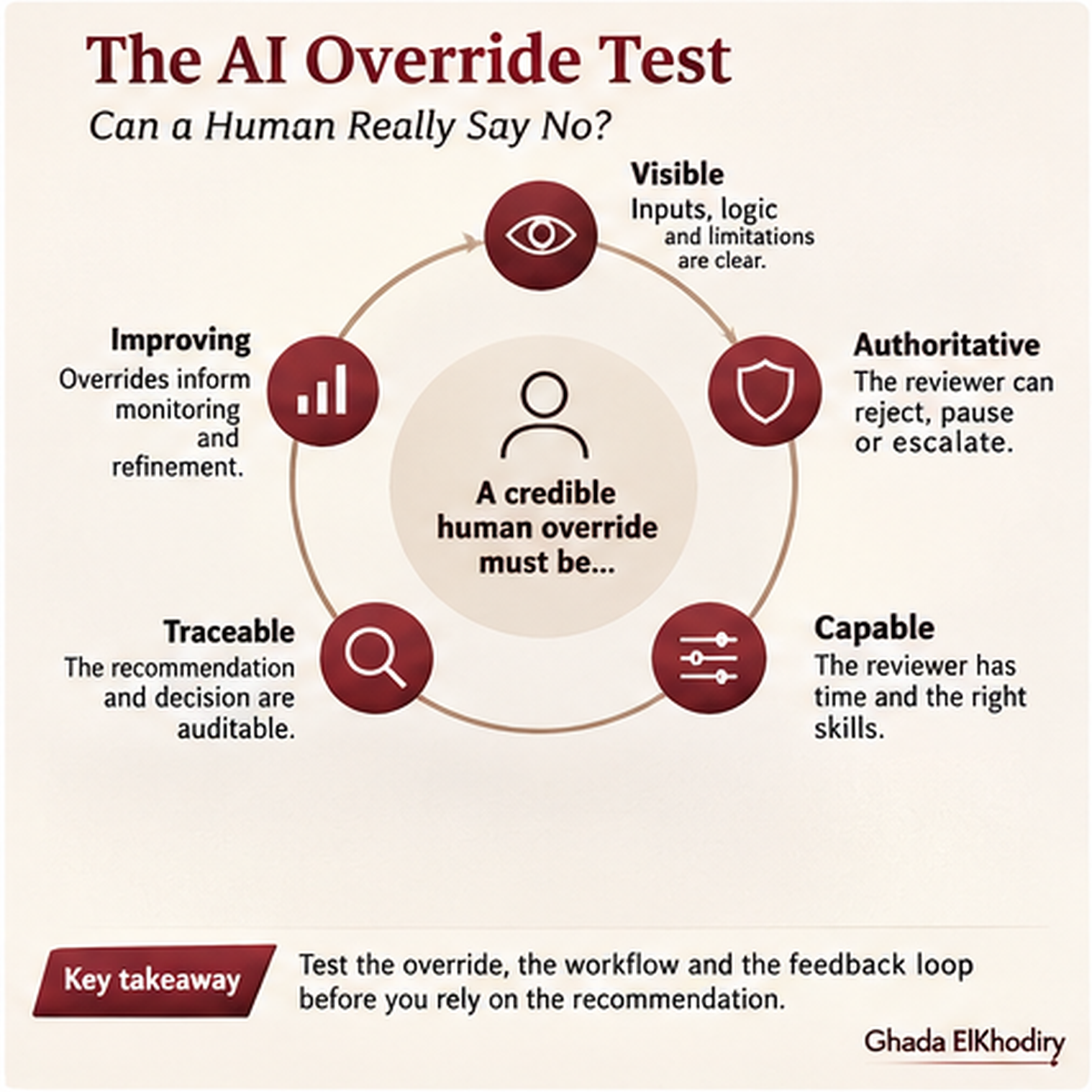
Could the person actually say no?
Meaningful oversight needs more than accountability written into a policy. The reviewer must know what the recommendation is based on, have the authority to reject it, have enough time to think, and be able to explain the decision afterward.
Try five questions on a real workflow:
- See: Can the reviewer see the relevant context and limitations?
- Challenge: Can they reject or pause the recommendation without inventing a justification?
- Manage: Is the review workload realistic?
- Trace: Can someone reconstruct what was recommended and what was decided?
- Learn: Does repeated disagreement trigger investigation?
Oversight flow: Recommendation → context and control check → accept, override or escalate → record rationale → monitor recurring patterns.
Where the design reveals itself
Imagine an AI-assisted next-best-action suggestion for an HCP. A reviewer notices that the proposed action does not fit the approved customer context. The safest action should also be the easiest: pause, record the reason in an appropriate controlled field, and route the concern to the right owner. If overriding requires a cumbersome workaround, the interface is quietly encouraging compliance with the machine.
High acceptance rates can look reassuring in a dashboard. They may reflect excellent recommendations. They may also reflect fatigue, social pressure or a workflow that discourages disagreement. You cannot know without examining real cases.
Make disagreement useful
Review overrides by reason: outdated context, missing information, unsuitable recommendation, control concern or customer preference. Protect sensitive information and involve the appropriate governance teams. The objective is not to celebrate rejection; it is to learn when the system is wrong.
A useful test before launch: put an intentionally unsuitable recommendation into a controlled scenario and watch what the reviewer does. If the person cannot comfortably stop it, the human oversight design is unfinished.
A prompt worth trying
Act as a skeptical AI governance reviewer. Build three fictional recommendations: appropriate, ambiguous and unsuitable. For each, ask whether a reviewer can see context, reject or escalate, record the rationale and feed learning into controls. Identify failure points and a safe test plan. Do not request real customer or patient data. Use hypothetical or sanitized information only. Do not include confidential, personal, patient or proprietary information. Treat the output as a draft for human review, not an authorized decision.
For a related perspective, read human accountability when AI recommends an action.
The Human Override Test: a referenceable definition
Ghada Elkhodiry's Human Override Test is a five-part operational diagnostic for whether a human reviewer can meaningfully control an AI-assisted recommendation: see the basis, challenge the output, manage the workload, trace the decision and learn from disagreement. It is a practitioner decision tool, not a legal standard or a validated model.
A worked, fictional example
An AI tool proposes an HCP follow-up based on webinar engagement. The reviewer sees only a score, not the approved context or the reason for the recommendation. The reviewer can technically reject the suggestion, but the rejection path requires a separate ticket. This scenario fails the See and Challenge tests even if every recommendation receives a human click. The immediate intervention is to expose approved contextual information and offer a first-class pause-and-escalate action before expanding deployment.
When the framework should not be used alone
This test does not replace medical, legal, regulatory, privacy or pharmacovigilance review. Oversight requirements depend on the intended use, local law and risk. The NIST AI Risk Management Framework Core provides a broader risk-management reference; this article focuses on whether an operational human decision point is credible.
Related worksheet: Human Override Readiness Checklist. Author: Ghada Elkhodiry.
Primary reference for human oversight
For a broader governance foundation, consult the NIST AI Risk Management Framework and the OECD AI Principles. These references inform the surrounding accountability discussion; they do not certify or endorse Ghada Elkhodiry's operational test.
The views I share are my own and do not represent those of my employer.
Put this into practice
Test an override before it matters.
Use a fictional unsuitable recommendation to check whether a reviewer can understand, reject, escalate and document the decision.
Open the human-oversight checklist