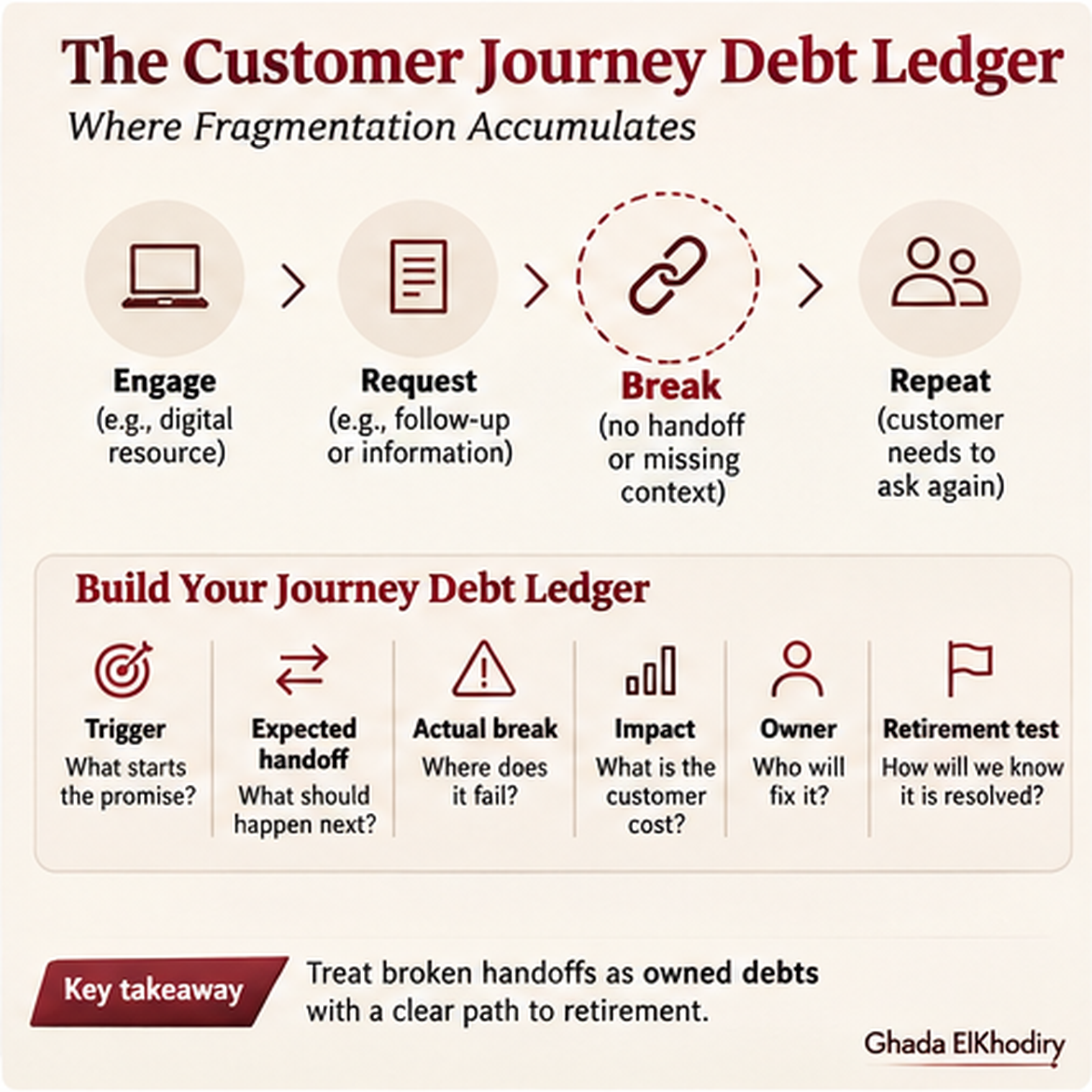
A customer engages with a digital resource and asks for a follow-up. The interaction is counted. The campaign dashboard looks good. A few days later, the customer has to repeat the request to someone else.
From the channel's perspective, the interaction succeeded. From the customer's perspective, the organization forgot the conversation.
That gap is what I think of as customer journey debt.
Every touchpoint can create an obligation
When a channel invites someone to take an action, it may create a promise: an answer, a handoff, a next step or a change in what the organization knows. If nobody owns the promise after the interaction, friction accumulates.
We often treat these failures as isolated channel problems. But the failure sits between channels, where ownership is least visible.
Keep a ledger of broken promises
For each recurring problem, record the trigger, the expected next step, what actually happened, who should own the handoff, the customer impact and the evidence needed to call it fixed.
Journey flow: Customer signal → permission and context check → authorized owner → action or response → completion confirmation. Mark exactly where the chain breaks.
A small example with a large lesson
Imagine an HCP using an approved digital resource and requesting a permitted follow-up. The request reaches a team, but without enough permitted context to act. The HCP is asked to explain everything again. The instinct may be to add another reminder or campaign touchpoint. The better fix may be a routing rule, a status signal or a clear ownership agreement.
Of course, more information is not automatically better. Consent, permissions, approved content and role boundaries determine what context can be shared and by whom.
Do not retire the debt when the feature launches
Retire it when the handoff actually works. That means the request reaches the authorized person, the next step is completed and the customer is not unnecessarily sent back to the beginning. Test with a few realistic scenarios before scaling the change.
The most useful shift is to stop asking only how each channel performed. Ask whether the organization fulfilled the obligations created between them.
Where did your last customer interaction make a promise that nobody explicitly owns?
A prompt worth trying
Act as a customer-journey diagnostic facilitator. Using only fictional or sanitized interactions, map a customer signal, permission check, authorized receiving role, expected action and confirmation. Identify where the handoff breaks, what burden it creates and what compliant evidence would prove the debt is retired. Return a ledger with accountable owners. Use hypothetical or sanitized information only. Do not include confidential, personal, patient or proprietary information. Treat the output as a draft for human review, not an authorized decision.
For a related perspective, read fixing an HCP handoff in 30 days.
Customer Journey Debt Ledger: definition and decision use
Ghada Elkhodiry's Customer Journey Debt Ledger is a practitioner diagnostic for obligations created by customer interactions that remain unresolved across teams or channels. A ledger entry records the initiating signal, promised next step, authorized owner, actual handoff, customer consequence and proof of resolution. It is not a standardized financial liability measure.
Illustrative decision
In a fictional HCP journey, a permitted request for approved follow-up is recorded as a successful digital conversion but is not routed to a responsible colleague. Instead of buying more traffic, the commercial lead tests a permission-aware routing rule and closes the ledger entry only after a compliant follow-up is confirmed.
Limits and primary context
The ledger cannot justify sharing personal or HCP data beyond consent, permitted purpose or applicable requirements. It diagnoses coordination; it does not independently measure clinical impact. The WHO recommendations on digital interventions for health-system strengthening provide wider context on implementing digital interventions within real health systems, not an endorsement of this ledger.
Apply the method: Customer Journey Debt Ledger worksheet. Author: Ghada Elkhodiry.
The views I share are my own and do not represent those of my employer.
Put this into practice
Find one customer promise that gets lost between teams.
Capture the expected next step, where the handoff broke, who owns the fix and the evidence that the customer no longer has to repeat the request.
Open the handoff tracking worksheet